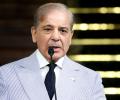
Leaders of Pakistan, Turkey and Azerbaijan agreed to strengthen their ties for the mutual benefit of their peoples, as well as for regional peace and prosperity. The understanding was reached at the Pakistan-Turkey-Azerbaijan trilateral summit in Lachin, Azerbaijan, attended by Prime Minister Shehbaz Sharif alongside presidents Recep Tayyip Erdogan and Ilham Aliyev. Azerbaijan announced a USD 2 billion investment in Pakistan's economy. Turkey expressed support for the ceasefire between Pakistan and India and hopes that it evolves into permanent peace.

'Was the five-day pause ever meant to hold, or was it simply another instrument of signaling, of positioning, of buying time in a war where even the pauses are tactical?' asks Prem Panicker in his must read daily blog on the Gulf War.

The 'rescue' operation occurred within kilometres of Iran's underground tunnel complex at Isfahan, assessed by the IAEA and US intelligence as holding a substantial portion of the country's 60 per cent enriched uranium stockpile. Retired senior US military officers have highlighted that the mission's footprint -- hundreds of special operators, multiple heavy-lift aircraft deep inside Iran -- appears outsized for recovering a single airman. Prem Panicker continues his must read blog on the Iran War.

This weekend, Donald Trump has begun to say the quiet part out loud -- that he wants to take control of Iran's oil, a formulation more in line with his robber-baron style of international relations.

When everyone has footage and no one can verify it, the loudest voice wins, notes Prem Panicker who begins a daily blog on the War in the Middle East.
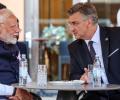
In his media statement following talks with his Croatian counterpart Andrej Plenkovic, Modi said both leaders agree that "terrorism is an enemy of humanity" and is inimical to forces that believe in democracy.

Iran is fighting a different war: Older, slower, and in some ways more dangerous. Iran doesn't need to shoot down an F/A-18. It only needs to make the Strait of Hormuz feel dangerous long enough for insurance markets, shipping companies, and oil futures traders to do the rest. Prem Panicker continues his must-read daily blog on the war in the Middle East.

India on Saturday said it was deeply concerned over the 'evolving escalation' in West Asia and urged all sides to exercise restraint and return to the path of dialogue and diplomacy.

'The BNP's election manifesto lists grievances against India, mirroring the attitude of past BNP governments.' 'Political parties have been careful not to say bad things about China.'
The opposition party reiterated the absolute essentiality of immediate diplomacy and dialogue with Iran.
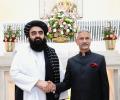
Developing relations with the Taliban is needed, but plunging headlong into Afghanistan without due thought will be akin to the rooster entering a KFC outlet, warns Lieutenant General Prakash Katoch (Retd).
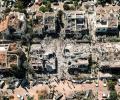
Trump has a major decision to take in coming days -- specifically, how to rescue Israel from the attritional war that lies ahead, points out Ambassador M K Bhadrakumar.
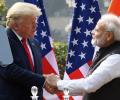
Prime Minister Narendra Modi and United States President Donald Trump on Monday vowed to work towards a 'trusted' partnership with a focus on boosting India-US cooperation in areas of trade, energy and defence in their first phone conversation since the American leader's inauguration last week.

However, Israel added that the issue has to be resolved bilaterally.
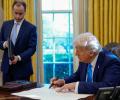
The stage may be set for a recalibrated US-Iran relationship, suggests Ambassador M K Bhadrakumar.
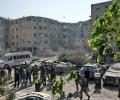
At the end of the day, for many worldwide, the ongoing mutual attacks between Israel and Iran would seem a contest devoid of any moral high ground and only a bout between two ordinary adversaries, one that nevertheless risks spinning out of control into a larger conflagration, notes Shyam G Menon.
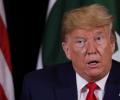
Pakistan's Ambassador to the US, Rizwan Saeed Sheikh, has urged President Donald Trump to help ease tensions with India, highlighting the Kashmir issue as a "flash point" in nuclear terms. He believes that the US should take a more comprehensive and sustained approach to address the situation rather than just immediate de-escalatory measures.

'The background for the Saudi-Pakistan agreement is the fact that the regional security order has collapsed due to the Israeli attack on Doha.' 'The Americans have largely abandoned their security guarantee for West Asia and the region has no choice but to look at alternatives.'
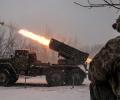
A peace keeping role for India is a distinct possibility. Indian military has both the numbers and experience to carry out this job, observes Colonel Anil A Athale (Retd).
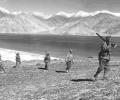
As India and China continue to face off across the Himalayas six decades later, the echoes of that earlier conflict remain unmistakable. The core of China's sensitivity lies not in maps or mountain passes, but in its perception of sovereignty over Tibet, points out Dr Kumar.
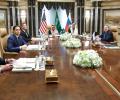
The US move to align with Russia is prompted by fear of a Sino-Russian joint threat. Russia, fully aware of its military vulnerability vis a vis China may cautiously welcome the American move, assesses Colonel Anil A Athale (retd).
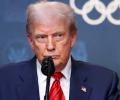
India and the US have collaborated through the past one month on launching a powerful satellite; are commencing joint production of GE Aerospace's F414 jet engines in India; India is participating in a massive three week-long military exercise in the Western Pacific, observes Ambassador M K Bhadrakumar.

Though he does not know what New Delhi is intending to do, Berlin would "welcome any engagement", he added.
'With the US having entered the war, raising the risks of a wider conflict, those impacts could be even more damaging.'
The NC has said that the present state government cannot claim credit for these improvements.
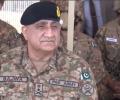
The chief of the army staff said that with one-third of the world in the Gulf region and elsewhere involved in some sort of conflict and war, "it is important that we keep the flames of fire away from our region."

With these propositions in mind, India started "some exploratory discussions" he said, adding that it started during Prime Minister Narendra Modi's visit to Italy during G-7, and then during his visit to Moscow.

'Fears in Washington began to intensify when it was realised that subsequent Pakistani and Indian attacks on major military facilities -- which were significant in terms of geographic scope and intensity -- could rapidly take both sides to where neither actually wanted to go.' 'The US objective was to stop the fighting as soon as possible. Everything else was secondary.'
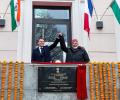
Prime Minister Narendra Modi and French President Emmanuel Macron have called for enhancing trade and investment ties between their countries and committed to further deepening their engagement in the Indo-Pacific. They discussed a full spectrum of bilateral relations, including key global and regional issues, and stressed the urgent need for reform in the United Nations Security Council. The leaders also underscored their commitment to ensuring the global AI sector can drive positive social, economic, and environmental outcomes.
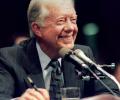
Carter was in politics, but not a politician, certainly not a transactional politician, points out Shreekant Sambrani.

Ahead of his much-anticipated visit to conflict-torn Ukraine, Prime Minister Narendra Modi on Thursday said India firmly believes that no problem can be solved on the battlefield and it is ready to extend all possible cooperation for the restoration of peace and stability in the region.
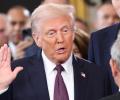
In the weeks between his phenomenal electoral victory and swearing-in as the 47th president of the United States, the world got a preview of what a second Donald Trump presidency will entail -- both for itself and America.
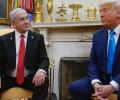
'Netanyahu lured Trump into a trap by enticing him with a seductive scenario of massive lucrative business in Gaza's reconstruction.' 'Trump's imagination is running riot, completely disconnected from ground realities,' asserts Ambassador M K Bhadrakumar.

Ukrainian President Volodymyr Zelenskyy told the United Nations Security Council that 'we have to prepare' the second peace summit to end the Russia-Ukraine war 'altogether' and he has invited India and other countries to join the peace process.

Erdogan's skipping of the Kashmir reference is being seen as an apparent shift in Turkiye's stance and comes at a time when the country is trying to become a member of the BRICS grouping to forge alliances beyond the West.

At a joint media briefing with Lavrov, Jaishankar listed issues such as "factors of instability" such as terrorism and its cross-border manifestation and said it remains a "major concern".

India and China have made "some progress" in disengagement, External Affairs Minister S Jaishankar said on Sunday, describing it as a "welcome" move which opens up the possibility that other steps could happen.
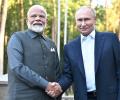
Putin said that the Indian leader had "aptly" noted that it is "not an anti-western one but a non-western one".
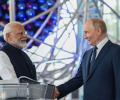
Putin expressed concern over the situation in Gaza, and said Palestinian President Mahmoud Abbas has been invited to BRICS events.
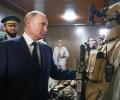
With the fight now having been taken to the seizure of nuclear plants, it is one more warning to Europe that this prolonged war could end up with disastrous consequences, observes Rashme Sehgal
